


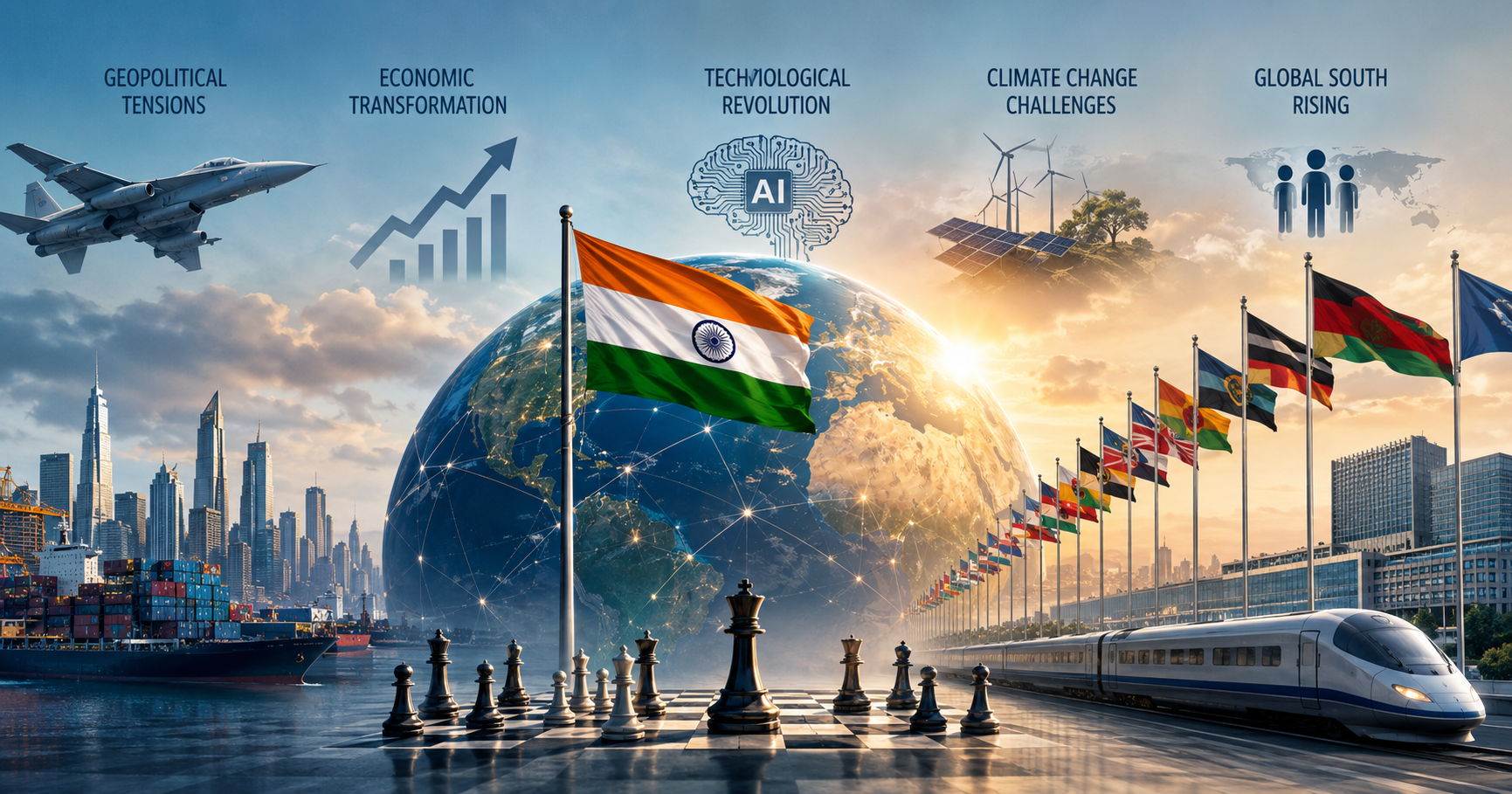
Global Situation 2026 analysis from India’s perspective. Explore geopolitical tensions, economic shifts, AI competition, climate challenges, and India’s growing role in shaping the future global order.
Editorial by: Rupesh Kumar Singh Follow Me
The world in 2026 stands at a historic turning point. The optimism that accompanied globalization in the late twentieth and early twenty-first centuries has largely faded, replaced by strategic competition, economic fragmentation, technological rivalry, and geopolitical uncertainty. From the wars in Europe and West Asia to the growing contest between the United States and China, the international system is undergoing a profound transformation. The age of cooperation is increasingly giving way to the age of competition.
For India, this changing world presents both risks and unprecedented opportunities. As the world’s most populous nation, one of its fastest-growing major economies, and a leading voice of the Global South, India is no longer merely an observer of global events. It is becoming one of the key actors shaping the future international order.
The Return of Hard Power
One of the defining features of today’s world is the return of hard power politics. Military strength, strategic alliances, and national security concerns have once again become central to international relations. The ongoing conflicts in Ukraine, tensions in the Middle East, and growing concerns surrounding Taiwan demonstrate that geopolitical rivalries remain far from resolved.
Many countries are increasing defense spending and prioritizing security over economic integration. International institutions such as the United Nations and the World Trade Organization are struggling to manage conflicts effectively, leading to a growing trust deficit in global governance.
For India, these developments reinforce the importance of maintaining strategic autonomy. New Delhi has consistently avoided choosing sides in major power rivalries, preferring instead to engage with multiple partners simultaneously. This policy of “multi-alignment” has enabled India to preserve flexibility while protecting its national interests.
Global Situation 2026: Economic Globalization Is Being Rewritten
The global economy is also undergoing significant changes. Supply chains are being restructured, trade barriers are increasing, and nations are prioritizing economic security over unrestricted globalization. Major economies are increasingly using tariffs, technology controls, and industrial policies as strategic tools.
The result is a more fragmented global economic landscape.
For India, however, this restructuring creates opportunities. Multinational corporations seeking alternatives to excessive dependence on any single manufacturing hub are increasingly looking toward India. The country’s growing digital infrastructure, large workforce, and expanding consumer market make it an attractive destination for investment.
Yet India cannot afford complacency. Manufacturing competitiveness, infrastructure development, judicial reforms, and skill development remain critical if the country wishes to fully capitalize on these shifts.
The AI Race Has Become the New Space Race
The twenty-first century’s most important strategic competition may not be over territory but technology. Artificial Intelligence has rapidly emerged as a defining factor in economic growth, military capability, and national influence. The competition among major powers to dominate AI development is intensifying.
Unlike previous technological revolutions, AI is reshaping every sector simultaneously from defense and healthcare to education and finance.
India possesses unique advantages in this domain. Its strong software industry, vast pool of engineers, and expanding startup ecosystem position it well to become a major AI power. However, success will depend on investments in research, semiconductor manufacturing, advanced computing infrastructure, and talent development.
The challenge for India is clear: it must move from being primarily a technology consumer to becoming a technology creator.
The Global South Is Finding Its Voice
Another major trend shaping today’s world is the growing influence of the Global South. Countries across Asia, Africa, and Latin America are demanding greater representation in international institutions and decision-making processes.
India has emerged as one of the strongest advocates of this movement. Through initiatives in development assistance, digital public infrastructure, and diplomatic engagement, New Delhi is increasingly positioning itself as a bridge between developed and developing nations.
This role carries significant responsibility. Leadership cannot be achieved through rhetoric alone; it requires delivering practical solutions to global challenges such as poverty, climate change, healthcare, and sustainable development.
Climate Change Remains the Silent Crisis
While wars and geopolitical rivalries dominate headlines, climate change continues to represent perhaps the greatest long-term threat facing humanity. Extreme weather events, water scarcity, food insecurity, and environmental degradation are affecting millions worldwide.
For India, climate change is not a distant concern but a present reality. Heatwaves, unpredictable monsoons, floods, and rising energy demands are already placing significant pressure on the economy and society.
The global challenge lies in balancing economic growth with environmental sustainability. Developing countries rightly argue that climate policies must not become obstacles to development, while developed nations must fulfill their commitments regarding finance and technology transfer.
India’s Moment Has Arrived
The defining question of the current era is not whether the global order is changing it clearly is. The real question is who will shape the emerging order.
India enters this period with considerable strengths:
- A rapidly growing economy.
- A young demographic profile.
- Expanding diplomatic influence.
- Strategic geographic location.
- Growing technological capabilities.
- Credibility among both developed and developing nations.
Yet challenges remain substantial. Economic inequality, employment generation, education quality, infrastructure modernization, and national security concerns require sustained attention.
The coming decade will test whether India can convert potential into power.
Conclusion
The world of 2026 is defined by uncertainty, fragmentation, and competition. The old assumptions of globalization are being questioned, international institutions are under strain, and technological disruption is accelerating.
In this environment, India has a rare opportunity. By maintaining strategic autonomy, strengthening economic resilience, investing in innovation, and championing a more inclusive global order, India can emerge not merely as a participant in world affairs but as one of the architects of the twenty-first century international system.
History often presents nations with defining moments. For India, that moment may be now. The choices made today will determine whether the country becomes a balancing power, a leading economy, and a global voice for stability in an increasingly turbulent world.


