


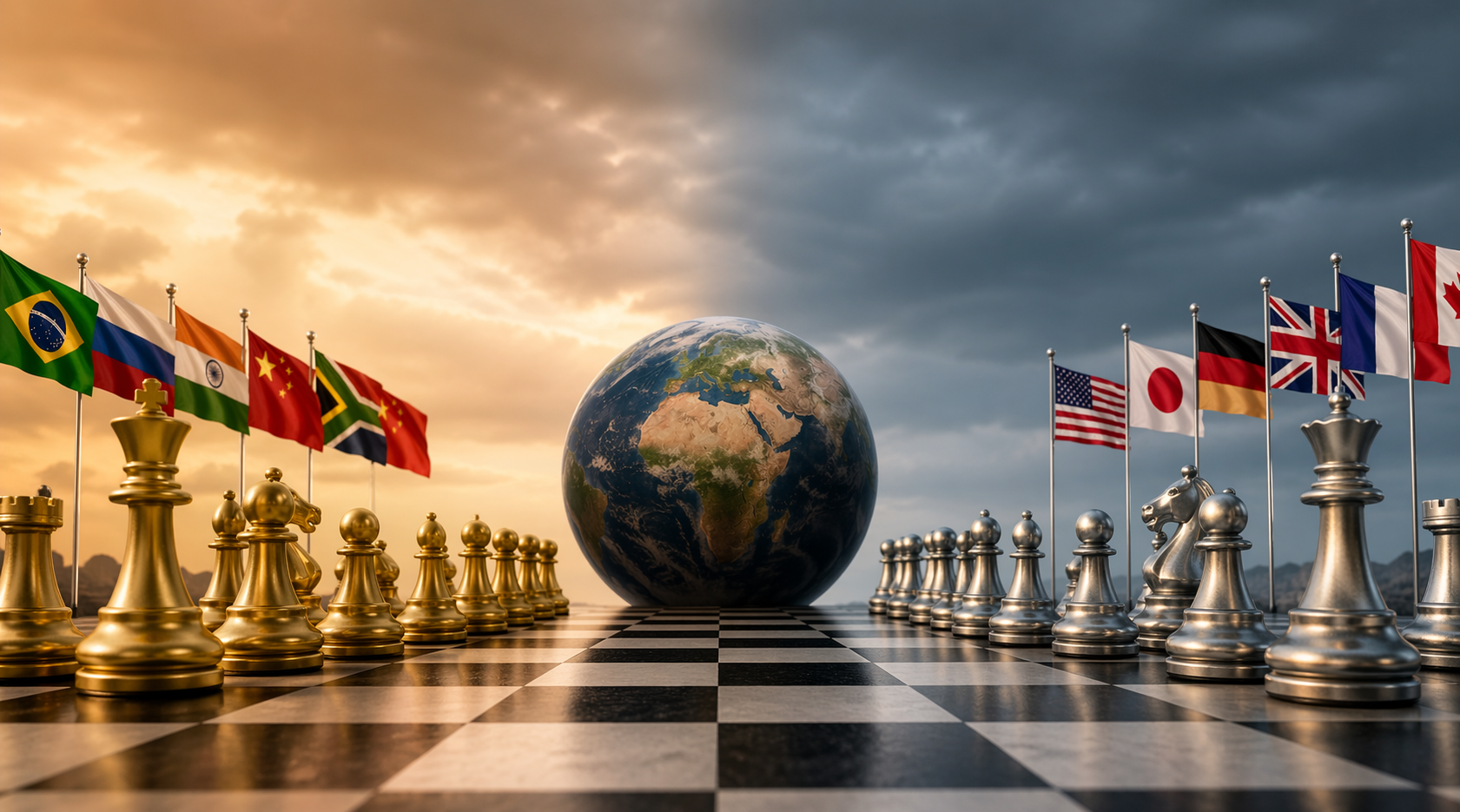
BRICS vs G7 is redefining global economic power in 2026 as emerging economies challenge Western dominance through trade alliances currency strategies and geopolitical influence
Article by: Rupesh Kumar Singh Follow Me
The global economic order in 2026 is witnessing a structural transformation that could redefine power dynamics for decades. At the center of this shift lies an intensifying competition between BRICS and G7. This is no longer just an economic comparison between developed and developing nations but a deeper ideological and strategic contest over who will control the future architecture of global finance trade and governance.
For decades the G7 dominated the global economy through institutions financial systems and geopolitical influence. Countries like the United States Japan Germany and the United Kingdom shaped global trade rules controlled major financial institutions and set the standards for economic policy worldwide. However the rise of BRICS which includes Brazil Russia India China and South Africa along with its recent expansion efforts has introduced a credible alternative to Western dominated frameworks.
One of the most significant developments in this rivalry is the growing push toward de dollarization. Several BRICS nations are actively exploring trade settlements in local currencies reducing dependence on the US dollar. This shift is not merely symbolic but strategic. By weakening the dominance of the dollar BRICS nations aim to gain financial sovereignty and reduce vulnerability to sanctions and external economic pressures. In contrast the G7 continues to rely on dollar centric systems which have historically reinforced its global influence.
Another critical dimension is the expansion strategy of BRICS. The bloc has shown clear intent to include more countries from Asia Africa and Latin America thereby increasing its geopolitical and economic footprint. This expansion reflects a broader trend where developing nations seek representation in global decision making structures that they feel have long been dominated by Western interests. As more countries align with BRICS the balance of power begins to tilt toward a multipolar world order.
Trade alliances are also undergoing a transformation. While the G7 focuses on strengthening existing partnerships and securing supply chains BRICS nations are building new corridors of cooperation. Infrastructure investments energy partnerships and digital trade agreements are becoming tools of influence. This has led to a fragmentation of global trade where countries are increasingly aligning based on strategic interests rather than purely economic efficiency.
BRICS vs G7
The implications of this shift are profound for global governance. Institutions that were once firmly under the influence of G7 nations now face pressure to reform and accommodate emerging economies. The demand for a more inclusive and representative global system is growing louder. If these demands are not addressed the world may witness the parallel development of alternative institutions led by BRICS nations.
India’s position in this evolving landscape is particularly noteworthy. As a member of BRICS and a strategic partner of several G7 countries India finds itself in a unique balancing role. Its ability to navigate between these two blocs could significantly influence the trajectory of global economic diplomacy. India’s emphasis on strategic autonomy reflects the broader trend among emerging economies to avoid alignment with any single power center.
Despite the momentum behind BRICS the G7 is far from declining into irrelevance. It still controls a significant share of global GDP technological innovation and financial capital. Moreover its institutional legacy and political cohesion provide a level of stability that BRICS has yet to fully achieve. Internal differences within BRICS especially between major players can pose challenges to its long term unity and effectiveness.
The competition between BRICS and G7 is not necessarily a zero sum game but it does indicate a transition from a unipolar to a multipolar economic order. This transition brings both opportunities and risks. On one hand it allows for greater representation and diversity in global decision making. On the other it introduces uncertainties that could lead to economic fragmentation and geopolitical tensions.
In conclusion the BRICS vs G7 rivalry in 2026 represents more than an economic contest. It is a reflection of a changing world where power is being redistributed and new voices are demanding a seat at the table. Whether this shift leads to cooperation or conflict will depend on how these blocs manage competition and whether they can find common ground in an increasingly interconnected yet divided global landscape.


