


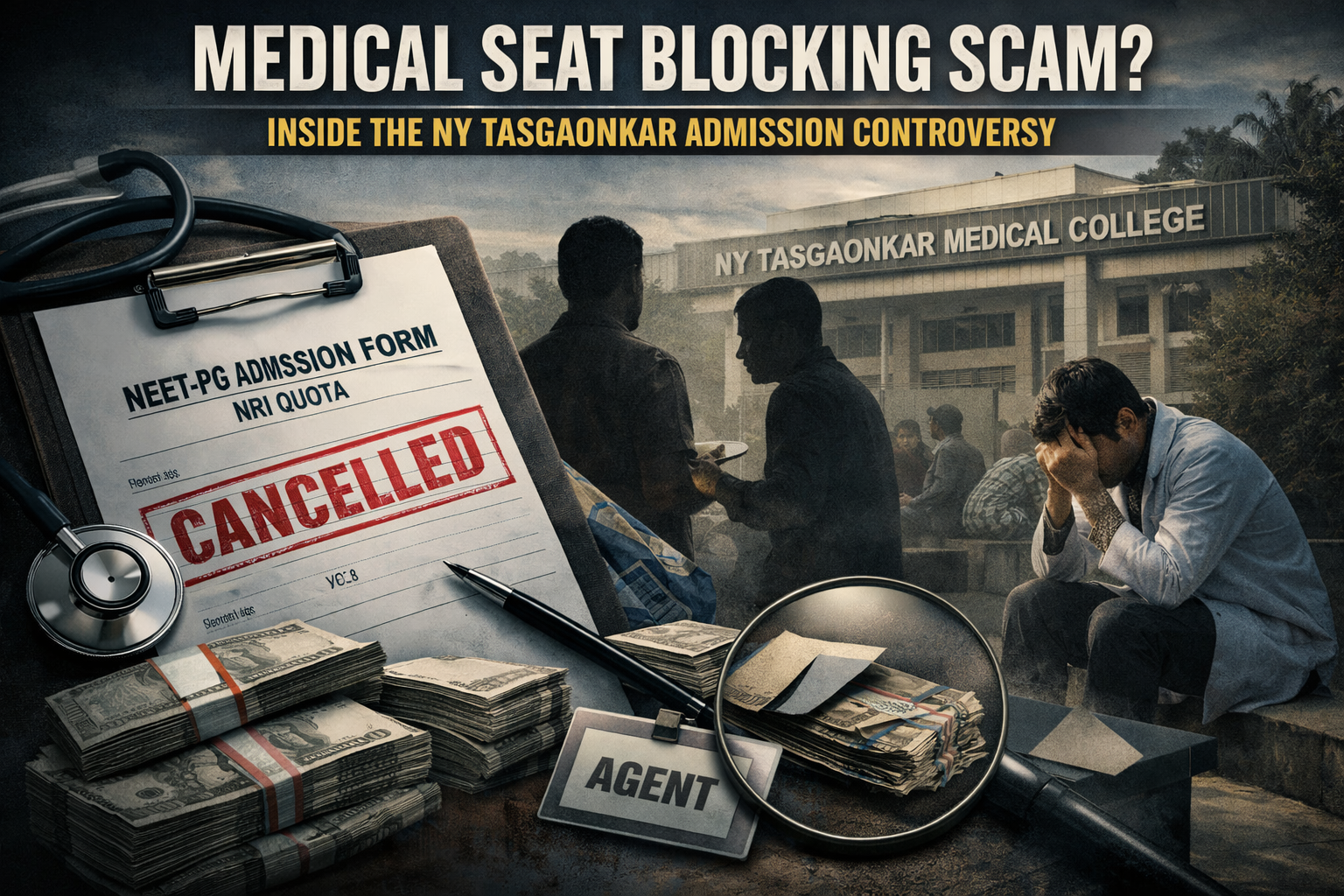
Medical seat blocking scam allegations have surfaced after 18 NEET-PG seats under NRI and institutional quota were suddenly cancelled at NY Tasgaonkar Medical College in Maharashtra. Experts say the pattern resembles the infamous Karnataka medical seat blocking scam, raising questions about sponsors, agents, and last-minute withdrawals.
Investigation by: Rupesh Kumar Singh Follow Me
A Medical Seat Blocking Scam Pattern? The Case That Needs Deeper Scrutiny
India’s medical admission system has faced repeated allegations of manipulation through seat blocking, particularly under high-fee management and NRI quotas. Now, a controversial episode at Dr. NY Tasgaonkar Institute of Medical Sciences (NYTIMS) in Karjat, Maharashtra, has reignited those concerns.
The controversy began when 18 postgraduate (PG) medical admissions under institutional and NRI quotas were suddenly cancelled, raising suspicion among student groups and regulators.
While a state-level inquiry committee later gave the college a clean chit, critics argue that the probe may have ignored key investigative angles including whether the incident resembles the seat-blocking scams previously exposed in Karnataka.
The case has now become a test of transparency in India’s medical counselling system.
The Trigger: 18 Seats Vacated at the Same Time
The issue first came to light during the NEET-PG counselling process in Maharashtra.
According to official reports:
18 students admitted under NRI quota suddenly cancelled their admissions.
The withdrawals occurred more than a month after they had enrolled and paid fees.
The cancellations happened within a narrow time window on February 24 and 25.
The withdrawals created an unusual situation where all high-fee quota seats suddenly became vacant simultaneously.
Experts immediately questioned the probability of such an event.
One senior admissions official reportedly asked:
“Can 18 doctors arrive at the same decision at the same time, especially if that decision costs each of them around ₹1.2 crore?”
Such synchronized withdrawals rarely occur in competitive postgraduate medical admissions.
Clean Chit But Questions Remain
Following the controversy, the Directorate of Medical Education and Research (DMER) formed an inquiry panel.
The committee contacted the 18 students, who reportedly told investigators that they voluntarily withdrew their admissions.
Based on these responses, the panel closed the investigation and cleared the college of wrongdoing.
However, critics say the inquiry had serious limitations.
One key concern raised by observers is that:
The committee reportedly relied on contact numbers provided by the college itself to reach the students.
This raises a critical question:
If the institution itself provided the communication channel, how independent was the verification process?
The Seat Blocking Mechanism: How Such Scams Typically Work
To understand why the NY Tasgaonkar case triggered alarm, it is important to examine how seat blocking scams operate in medical admissions.
In a typical seat-blocking racket:
Agents or brokers arrange proxy candidates to take admission temporarily.
These candidates occupy seats during counselling rounds.
Once genuine high-paying students are ready, the proxies withdraw at the last moment.
The vacated seats are then re-allocated in special institutional rounds.
The purpose is simple:
Control seat supply and drive prices higher.
In some cases, investigators have alleged the use of “jockey candidates” stand-ins who occupy seats temporarily so that preferred candidates can secure them later.
Why the Pattern Looks Familiar
Critics say the NY Tasgaonkar case resembles patterns seen in previous seat-blocking scandals.
Several suspicious elements stand out:
1. Mass Withdrawals
All 18 admissions under NRI and institutional quotas were cancelled together.
In a merit-based counselling system, synchronized withdrawal is statistically unlikely.
2. Timing Advantage
After the cancellations, the college reportedly approached the Bombay High Court for a special institute-level admission round to fill the seats.
This meant the college could potentially fill the seats outside the normal centralized counselling process.
3. Advance Legal Preparation
Student organizations allege the college had filed a writ petition even before the cancellations were officially processed, suggesting possible prior knowledge.
If true, this would indicate advance planning rather than spontaneous withdrawals.
The Karnataka Seat Blocking Precedent
The fears surrounding the Maharashtra case are amplified by a similar controversy in Karnataka a few years ago.
In that case:
Allegations surfaced of a massive medical seat blocking racket worth over ₹1100 crore.
Investigators claimed organized networks used proxy candidates and agents to manipulate the counselling process.
Retired police officials publicly raised alarms about systematic admission manipulation.
The Karnataka case demonstrated that seat blocking can be highly organized, involving agents, brokers, and sometimes institutional complicity.
This precedent is precisely why the NY Tasgaonkar episode is being viewed with suspicion.
The Questions the Inquiry Should Have Asked
Critics argue that a deeper probe should examine several crucial aspects.
1. Who Sponsored the NRI Candidates?
Under NRI quota rules:
Students must either be NRIs themselves
Or be sponsored by close NRI relatives.
Investigators should verify:
Who sponsored the 18 students?
Were the sponsors genuine relatives?
Were the fees paid from the sponsor’s bank accounts?
If the financial trail leads to unrelated third parties, it may indicate proxy admissions.
2. What Was the Family Background of the Students?
A serious investigation would check:
Whether the students had actual NRI family connections
Whether documents proving those relationships were verified
Whether the NRI sponsors had legitimate financial links
Fake sponsorship documents are a common technique used in seat blocking schemes.
3. Were Agents Involved?
“Sources claim that TWO AGENTS – whose names will be revealed in the next story – were repeatedly present during counselling activities related to the college.”
If true, investigators should examine:
Their communication records
Their role in connecting candidates with the institution
Whether they handled payments or documentation
In many admission scams, agents act as middlemen between candidates and institutions.
4. Why Did the College Publish a Special Admission Contact Number?
Another unusual detail involves the college website.
Reports suggest the institute published a special phone number for PG admission inquiries, despite the process being officially conducted online.
This raises further questions:
Who operated that phone line?
Were calls linked to admission negotiations?
Were the call logs and ownership details examined by the inquiry committee?
A Wider Structural Problem
India’s medical admission system is extremely competitive.
Every year:
Thousands of students compete for limited MD/MS seats
Private colleges charge ₹50 lakh to ₹1.5 crore for NRI quota seats
These high stakes create incentives for manipulation.
Even regulators acknowledge that seat blocking and fake documentation have appeared in several states.
Why a High-Level Probe May Be Necessary
If the Maharashtra case is truly similar to the Karnataka scandal, the implications could be serious.
A thorough investigation should include:
Financial audit of NRI fee payments
Verification of sponsor relationships
IP address tracking of online registrations
Analysis of demand drafts and bank transactions
Identification of agents or intermediaries
Without such steps, critics argue, the truth behind the mass withdrawals may never emerge.
Who Ultimately Loses in Such Cases
Whenever seat blocking or admission manipulation occurs the biggest loss is suffered by meritorious students.
Thousands of medical graduates across India compete every year for a limited number of postgraduate seats.
If seats are temporarily occupied by proxy candidates it reduces opportunities for genuine aspirants.
It also damages public confidence in the fairness of the admission system.
Medical education is supposed to operate strictly on merit and transparency.
Any attempt to manipulate that system affects not only students but also the quality and credibility of the healthcare system itself.
Our Investigation Continues
At this stage the NY Tasgaonkar case may appear closed from an official standpoint. However many aspects of the episode still raise serious questions that deserve deeper examination.
The pattern of simultaneous withdrawals the nature of the quota seats and the timing of the cancellations are factors that cannot be ignored in a system already vulnerable to admission manipulation.
Our investigation into this possible medical seat blocking scam is still continuing.
In our upcoming article we will present further findings and attempt to expose the individuals and networks that may be operating behind the medical seat blocking system.
If a coordinated network is indeed working behind such admissions it is important that it is brought into public view so that the integrity of India’s medical education system can be protected.


