


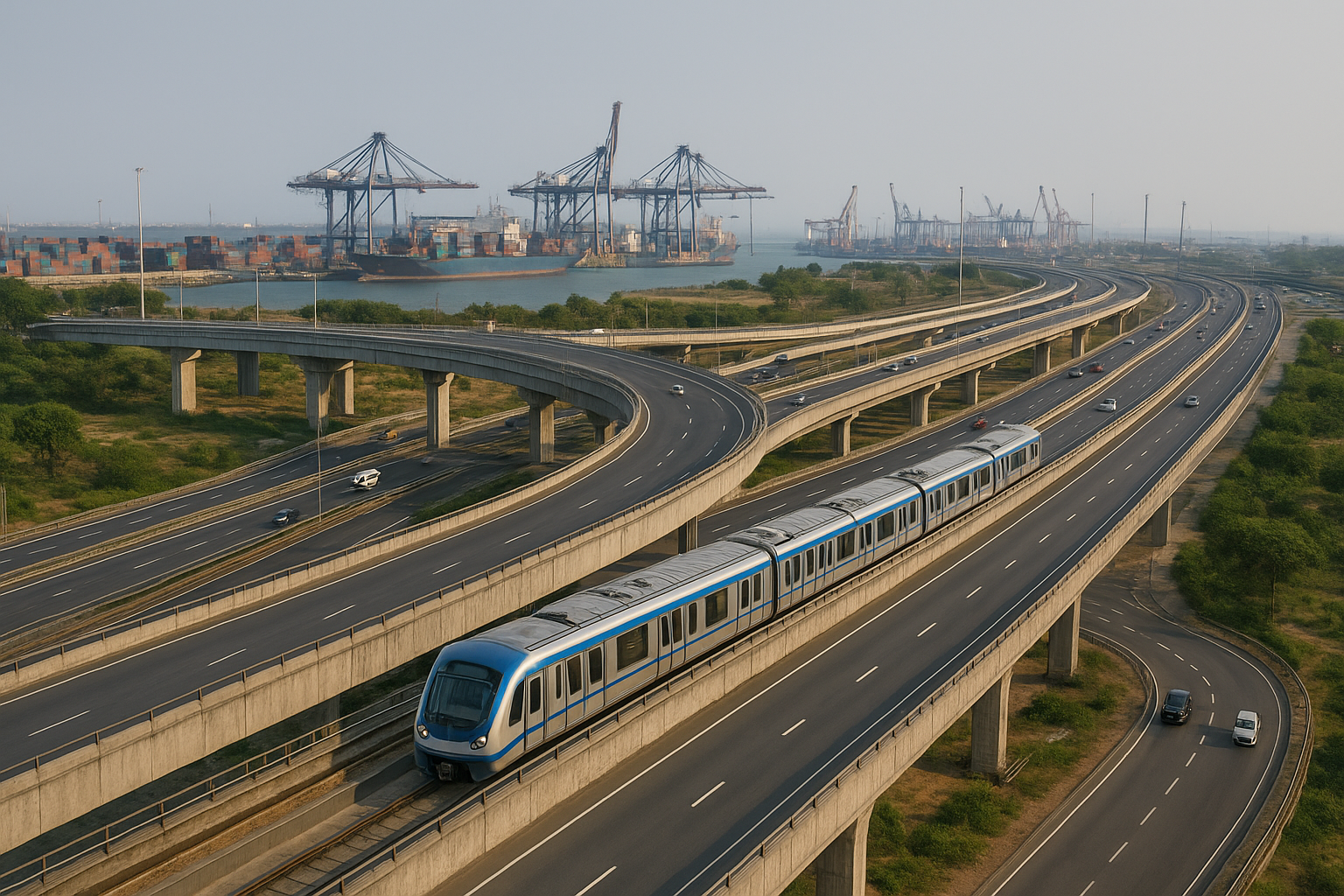
Infrastructure Push is driving India’s $5 trillion economy target, with roads, transport, and urban projects shaping growth, jobs, and global investment.
Special Report by: Rupesh Kumar Singh
India’s journey toward becoming a $5 trillion economy has found its backbone in one central idea: Infrastructure Push. The government has consistently highlighted infrastructure as the key lever to transform the nation’s growth trajectory, attract global investment, and provide jobs on a massive scale. From highways and expressways to renewable energy projects and modern urban development, the strategy revolves around creating assets that directly boost productivity and economic activity.
This analytical article explores the economic rationale behind the Infrastructure Push, the policy measures enabling it, the role of private and foreign investment, and the challenges India must navigate to truly achieve its ambitious $5 trillion target.
Infrastructure as the Engine of Growth
Infrastructure is not just about roads or buildings-it forms the foundation of economic competitiveness. When transport networks improve, logistics costs reduce, industries grow, and exports become more competitive. India currently spends nearly 7-8% of its GDP on logistics, compared to global best practices of 4-5%. By pushing for better highways, multimodal transport, and smart urban infrastructure, the government aims to lower costs and increase efficiency for businesses.
The Infrastructure Push is also linked directly to employment generation. Road construction alone creates millions of direct and indirect jobs, while housing projects, metro systems, and renewable energy initiatives add further layers of opportunity. Thus, infrastructure becomes both a short-term economic stimulant and a long-term driver of sustainable growth.
Policy Vision and Government Strategy
The government’s long-term vision is clearly outlined through flagship programs like Bharatmala for highways, Sagarmala for ports, the National Infrastructure Pipeline (NIP), and Gati Shakti for integrated planning. Each of these programs reflects a systematic approach: aligning capital expenditure with industrial policy, while ensuring that infrastructure creation aligns with India’s demographic and geographic realities.
Nitin Gadkari, the Union Minister for Road Transport and Highways, has been particularly vocal about the role of connectivity projects. His statements emphasize that world-class highways, expressways, and tunnels are not just construction feats but catalysts for regional equity. Better road connectivity reduces rural isolation, opens new markets for farmers, and creates business ecosystems in small towns key ingredients for inclusive growth.
Private and Foreign Investment: A Vital Component
No infrastructure plan can rely solely on government budgets. India has been proactive in creating space for private and foreign investment in roads, airports, renewable energy, and real estate. Public-Private Partnerships (PPPs) are once again gaining traction as a financing model, particularly in highway construction and urban transit.
Foreign investors are watching India’s Infrastructure Push closely. Sovereign wealth funds, pension funds, and global infrastructure firms see India as a high-growth market with long-term returns. The rise of infrastructure investment trusts (InvITs) has also given investors a stable framework to park money while supporting national projects.
The presence of foreign capital not only reduces fiscal pressure but also brings advanced technology and management expertise, ensuring projects are executed faster and more efficiently.
Economic Implications for India’s $5 Trillion Dream
The $5 trillion economy target is not just about GDP numbers – it is about expanding India’s role in global value chains. The Infrastructure Push directly supports this by making India a more competitive manufacturing and services hub.
For example, reliable highways and dedicated freight corridors reduce supply chain delays, helping Indian manufacturers compete globally. Better airports and seaports allow for smoother export operations, while renewable energy infrastructure strengthens India’s credentials as a sustainable investment destination.
Urban development projects, including metro systems, smart cities, and housing schemes, further amplify productivity by improving living standards and easing the pressures of rapid urbanization. Each of these elements ties into the larger growth narrative.
Challenges on the Path
While the Infrastructure Push is ambitious, it is not without hurdles. Land acquisition remains one of the biggest roadblocks, often delaying projects for years. Financing, though improved by private participation, still faces constraints when global capital markets tighten.
Environmental concerns are another critical dimension. Building highways through ecologically sensitive zones or large hydropower projects often face opposition, forcing policymakers to strike a delicate balance between development and sustainability.
Finally, execution capacity at the state and local level sometimes lags behind national ambitions. Without efficient on-ground implementation, the benefits of big announcements can remain unrealized.
Opportunities for Businesses and Citizens
Despite challenges, the opportunities created by the Infrastructure Push are undeniable. Construction firms, cement and steel companies, logistics operators, and renewable energy providers are witnessing direct benefits. At the same time, startups working in smart mobility, urban solutions, and green construction technologies are also finding a growing ecosystem.
For citizens, better infrastructure means reduced travel times, safer roads, affordable housing, and more job opportunities. Rural India, often left behind in earlier growth cycles, stands to gain significantly from connectivity projects that open markets and integrate villages into the national economy.
READ MORE: TMC Opts Out of JPC: Opposition Unity at Risk?
Conclusion: Is the $5 Trillion Goal Achievable?
The Infrastructure Push is not a magic wand, but it is the closest India has to a realistic growth engine. By building assets that last for decades, the government ensures compounding returns for the economy. However, achieving the $5 trillion mark will depend on how effectively these projects are executed, financed, and integrated with industrial and social policy.
If India can overcome the hurdles of land, finance, and sustainability, the Infrastructure Push could transform not just GDP numbers but the very structure of its economy. In that sense, the push toward infrastructure is more than a developmental strategy-it is the foundation of India’s future as a global economic powerhouse.


