


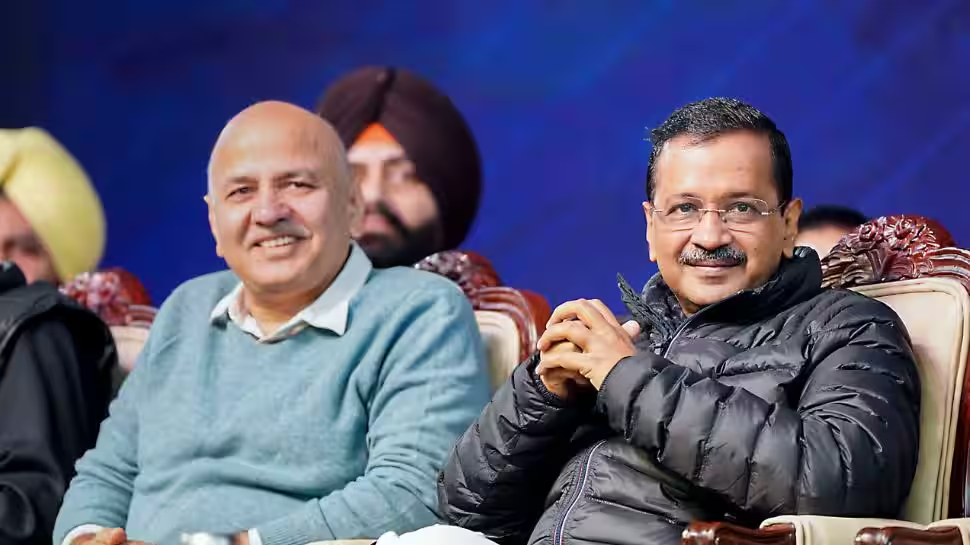
Arvind Kejriwal Court Order brings major relief as Delhi’s Rouse Avenue Court acquits Arvind Kejriwal and Manish Sisodia in the excise policy case, citing lack of evidence and weak prosecution arguments.
Article by: Rupesh Kumar Singh Follow Me
In a significant legal development, the Arvind Kejriwal Court Order delivered by the Rouse Avenue Court has resulted in the acquittal of Arvind Kejriwal and Manish Sisodia in the high-profile Delhi excise policy case. The court ruled that the prosecution failed to establish sufficient evidence to proceed with charges, granting relief to all accused individuals in the matter.
The judgment marks a crucial turning point in a case that has dominated political discourse and legal debate over the past several months.
Background of the Case
The controversy revolved around the 2021–22 Delhi Excise Policy, which was introduced with the stated objective of reforming the liquor trade in the national capital. However, allegations soon surfaced claiming irregularities, preferential treatment to certain vendors, and procedural lapses.
The case was investigated by the Central Bureau of Investigation (CBI), which alleged criminal conspiracy and corruption in the formulation and implementation of the policy. Both Kejriwal and Sisodia were named among key accused figures.
The matter attracted national attention due to its political implications, especially given Kejriwal’s role as a prominent opposition leader.
Court’s Key Observations
During the proceedings, the Rouse Avenue Court examined the evidence presented by the CBI. According to the court order:
The prosecution failed to demonstrate a clear criminal conspiracy.
Documentary and testimonial evidence did not conclusively establish wrongdoing.
Procedural irregularities alleged by investigators were not supported by legally sustainable proof.
The judge emphasized that suspicion alone cannot substitute for concrete evidence in criminal proceedings. As a result, the court discharged all accused persons in the case.
Reaction from the Leaders
Following the verdict, Arvind Kejriwal described the decision as a “victory of truth,” asserting that the allegations were politically motivated. Manish Sisodia also welcomed the ruling, stating that the court’s findings reaffirmed their stand from the beginning.
Political reactions across party lines have been mixed. Supporters of the Aam Aadmi Party (AAP) hailed the verdict as vindication, while critics indicated that legal options, including appeals, may still be explored.
What Happens Next?
Legal experts suggest that the CBI retains the option to challenge the order in the Delhi High Court if it believes procedural or legal grounds exist for appeal. Until such a step is taken, the acquittal stands as a substantial relief for the accused.
The verdict is expected to influence ongoing political narratives in Delhi and at the national level, particularly with upcoming electoral considerations in mind.
READ MORE: CBI Digital Arrest Fraud Case: CBI Conducts Nationwide Raids in ₹1.86 Crore Digital Arrest Fraud Case, Arrests Three
Political and Legal Significance
The Arvind Kejriwal Court Order is significant not only from a legal standpoint but also in terms of governance and political accountability. The case had been cited frequently in debates concerning corruption, investigative transparency, and the role of central agencies in politically sensitive matters.
With the acquittal, attention may now shift to broader questions regarding institutional oversight, judicial scrutiny, and the future trajectory of anti-corruption investigations in India.
Conclusion
The Arvind Kejriwal Court Order has reshaped the trajectory of the Delhi excise policy case. By acquitting Arvind Kejriwal, Manish Sisodia, and other accused individuals, the Rouse Avenue Court underscored the importance of evidentiary standards in criminal law.
While the political implications will continue to unfold, the legal chapter, for now, concludes with a clear message from the judiciary: allegations must be supported by substantial and admissible evidence to sustain prosecution.


