


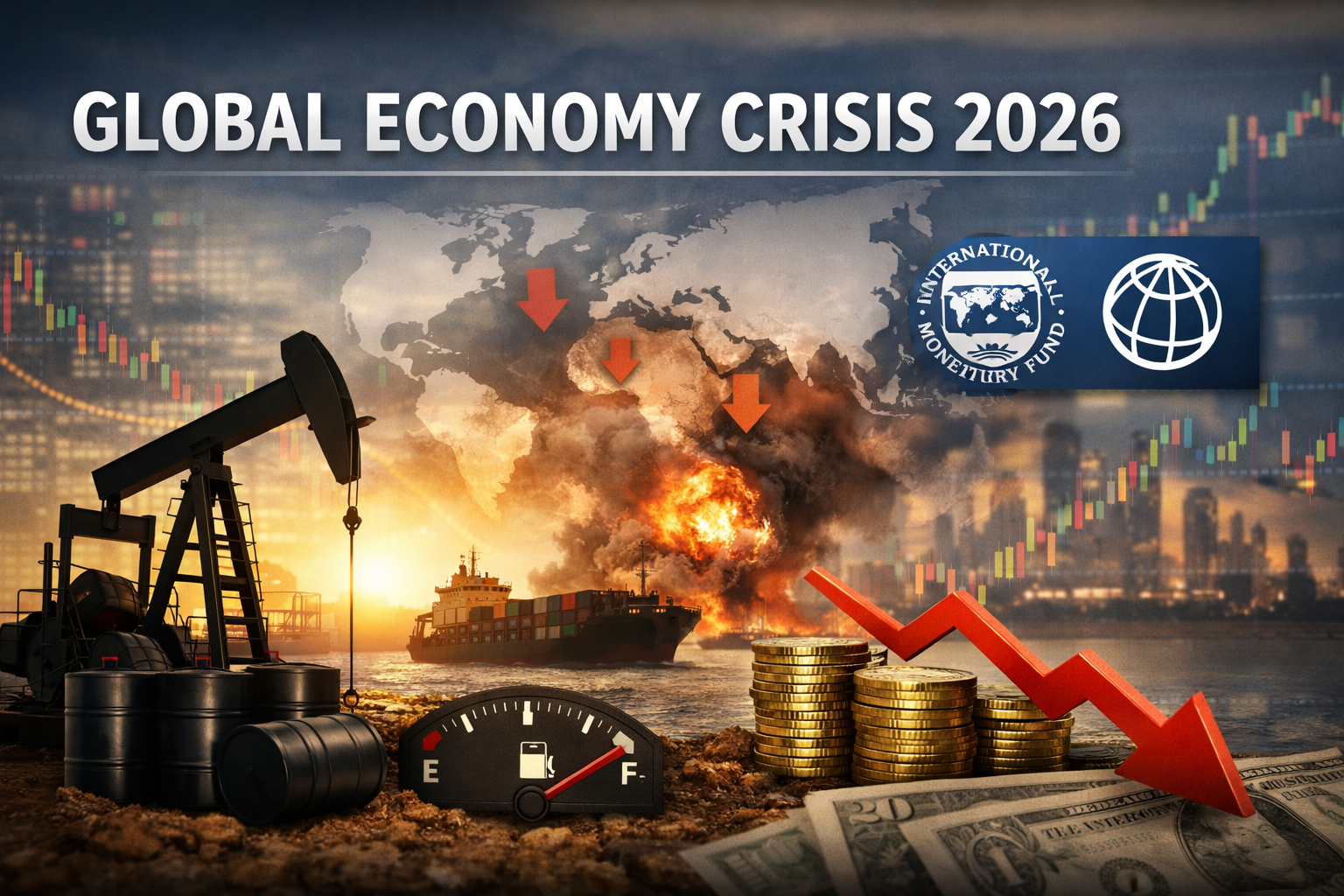
Global Economy Crisis 2026 is deepening as IMF and World Bank warn about rising inflation, oil shocks, and recession risks due to escalating Middle East tensions.
Article by: Rupesh Kumar Singh Follow Me
Global Economy Crisis 2026 is emerging as one of the most critical economic challenges of the decade. With escalating tensions in the Middle East disrupting energy supply chains, global institutions like the IMF and World Bank have issued strong warnings about a potential economic slowdown. Rising oil prices, inflationary pressure, and geopolitical instability are collectively pushing the global economy toward uncertainty.
Rising Geopolitical Tensions and Economic Shock
The ongoing conflict in the Middle East has once again highlighted how deeply interconnected geopolitics and economics are. The Strait of Hormuz, a vital artery for global oil transport, is facing renewed threats. Any disruption in this region directly affects nearly 20% of the world’s oil supply.
As tensions escalate, insurance costs for oil shipments have increased, supply chains are under stress, and global markets are reacting with volatility. This situation has triggered immediate concerns among global financial institutions.
IMF and World Bank’s Warning Signals
Both the IMF and World Bank have expressed serious concerns regarding the Global Economy Crisis 2026. Their latest assessments point toward three major risks:
1. Inflation Surge
Energy prices are a key driver of inflation. With crude oil prices rising sharply, transportation, manufacturing, and food costs are expected to increase globally.
2. Slowing Growth
Higher costs and uncertainty reduce investment and consumption. Developing economies are particularly vulnerable due to limited fiscal flexibility.
3. Financial Market Instability
Stock markets, currency values, and bond yields are becoming increasingly volatile. Investors are shifting toward safer assets, indicating fear of a potential downturn.
Oil Prices and Energy Crisis
One of the biggest triggers of the Global Economy Crisis 2026 is the sharp rise in oil prices. Energy markets are extremely sensitive to geopolitical disruptions, and even minor escalations can lead to significant price spikes.
- Oil-importing countries face rising import bills
- Industrial production costs increase
- Renewable energy transition slows due to short-term fossil fuel dependence
This energy shock has a cascading effect across all sectors, making it a central concern in global economic analysis.
Impact on Developing Economies (Including India)
Developing nations like India are at a critical juncture. While India has diversified its oil imports in recent years, it still relies heavily on external energy sources.
Key Challenges:
- Rising fuel prices leading to domestic inflation
- Pressure on currency due to higher import bills
- Increased fiscal burden on government subsidies
However, India also has strategic advantages such as strong domestic demand and policy flexibility, which may help cushion the impact.
Risk of Global Recession
Economists are increasingly discussing the possibility of a global recession. While a full-scale recession is not yet confirmed, the indicators are concerning:
- Declining global trade growth
- Tight monetary policies by central banks
- Weak consumer confidence
If the current geopolitical situation persists, the Global Economy Crisis 2026 could evolve into a broader financial downturn.
Strategic Responses and Policy Measures
Governments and institutions are actively exploring strategies to mitigate the crisis:
1. Diversification of Energy Sources
Countries are accelerating investments in renewable energy to reduce dependency on volatile oil markets.
2. Monetary Policy Adjustments
Central banks are balancing inflation control with growth support, a challenging task in the current scenario.
3. Strengthening Supply Chains
Efforts are being made to localize production and reduce reliance on conflict-prone regions.
Conclusion
The Global Economy Crisis 2026 is not just a temporary disruption but a complex, multi-layered challenge driven by geopolitics, energy markets, and financial instability. The warnings from IMF and World Bank highlight the urgency for coordinated global action.
For countries like India and other developing economies, the coming months will be crucial in navigating this uncertain landscape. Strategic planning, policy innovation, and global cooperation will determine how effectively the world manages this emerging crisis.


